


Leadership Coaching: What It Is, Benefits, and How It Works
Strong leadership requires the ability to communicate clearly, make informed decisions, manage teams, and adapt to workplace challenges. Leadership coaching provides a structured approach to developing these capabilities by helping leaders understand their behaviors, identify areas for growth, and strengthen relevant leadership skills.
Leadership coaching focuses on the individual’s goals, responsibilities, and development needs. It can support emerging and experienced leaders in building self-awareness and applying practical improvements in the workplace. This guide explains how leadership coaching works, its importance, different coaching types, and how to choose the right approach.
What Is Leadership Coaching?

Leadership coaching is a personalized development process that helps individuals improve how they lead, communicate, make decisions, and manage workplace challenges. It focuses on the leader’s specific goals, strengths, and development needs rather than applying the same approach to everyone.
Through structured conversations, feedback, reflection, and goal setting, leaders can build greater self-awareness and develop practical skills they can apply in their roles. Leadership coaching can benefit emerging leaders, managers, and executives facing new responsibilities or complex workplace challenges.
Why Is Leadership Coaching Important?

Leadership coaching is important because it helps leaders address specific development needs and respond more effectively to workplace challenges.
According to Gallup’s State of the Global Workplace 2026, 27% of employees in the UAE were engaged at work, compared with 14% across the Middle East and North Africa. This highlights the importance of effective leadership and people management in the workplace.
Key reasons leadership coaching is important include:
- Builds self-awareness: Helps leaders understand their strengths, behaviors, and areas that need development.
- Improves communication: Supports clearer communication with employees, teams, and other stakeholders.
- Strengthens decision-making: Helps leaders evaluate situations, consider different perspectives, and make more informed decisions.
- Supports people management: Develops skills for providing feedback, managing performance, and handling workplace challenges.
- Helps leaders manage change: Supports leaders as they navigate new responsibilities, organizational changes, and evolving business needs.
- Encourages continuous development: Helps leaders set development goals, reflect on their progress, and continue improving their leadership skills over time.
How Does Leadership Coaching Work?
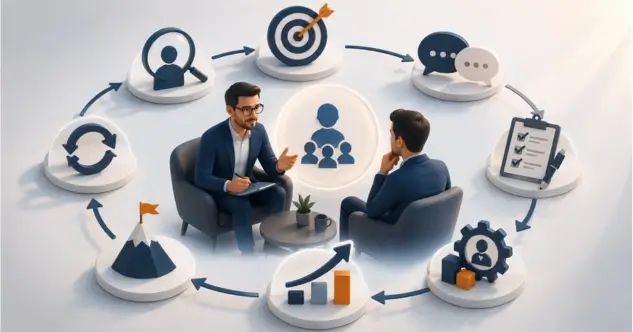
Leadership coaching typically works through a structured, goal-focused process tailored to the individual leader. Rather than providing general leadership advice, the coach helps the leader identify specific development priorities, reflect on current behaviors, and apply practical changes in the workplace.
The process may include:
- Assessing Current Leadership: Identifying strengths, behaviors, challenges, and areas that need development.
- Setting Development Goals: Defining clear leadership goals based on the individual’s role, responsibilities, and professional needs.
- Structured Coaching Sessions: Using focused conversations, questions, feedback, and reflection to explore workplace situations and leadership challenges.
- Creating Action Plans: Turning insights from coaching sessions into practical actions that can be applied at work.
- Applying New Approaches: Testing new communication, decision-making, delegation, or people-management approaches in real situations.
- Reviewing Progress: Evaluating what has changed, identifying remaining challenges, and adjusting development priorities when necessary.
- Continuous Development: Reinforcing effective behaviors and helping the leader continue developing beyond individual coaching sessions.
What Skills Can Leadership Coaching Develop?

Leadership coaching can help individuals develop practical skills that support their day-to-day leadership responsibilities. These may include:
- Communication skills: Communicating expectations, ideas, and feedback clearly across different workplace situations.
- Decision-making: Evaluating options, considering different perspectives, and making informed decisions.
- Emotional intelligence: Recognizing and managing emotions while responding effectively to others.
- Conflict management: Handling disagreements constructively and addressing workplace issues before they escalate.
- Delegation: Assigning responsibilities effectively while maintaining appropriate accountability.
- Feedback skills: Giving and receiving constructive feedback that supports individual and team development.
- Strategic thinking: Looking beyond immediate tasks to consider priorities, risks, and longer-term objectives.
- Adaptability: Adjusting leadership approaches when teams, responsibilities, or organizational circumstances change.
Who Can Benefit From Leadership Coaching?

Leadership coaching can benefit professionals at different career stages, particularly when their roles involve leading people, making decisions, or managing change. It may be useful for:
- Emerging leaders: Professionals moving into their first leadership role who need to develop skills such as delegation, communication, and team management. For example, an employee promoted to team leader may need support adjusting from completing tasks independently to managing the performance of others.
- Managers: Individuals responsible for teams who want to improve how they communicate, provide feedback, resolve conflicts, or manage performance.
- Senior leaders and executives: Experienced leaders dealing with complex decisions, organizational priorities, or larger teams and responsibilities.
- Leaders taking on new responsibilities: Professionals moving into a larger role, managing a new team, or taking responsibility for a different business area. For example, a manager promoted to department head may need to adapt their leadership approach to manage multiple teams rather than one.
- Leaders managing organizational change: Individuals responsible for guiding teams through restructuring, growth, new processes, or other workplace changes.
- High-potential employees: Professionals being prepared for future leadership positions who need to strengthen specific capabilities before taking on greater responsibility.
For women preparing to step into leadership roles or looking to strengthen their skills in team management, communication, and decision-making, women’s leadership training programs can provide targeted development to help them prepare for greater professional responsibilities.
What Are the Different Types of Leadership Coaching?

Leadership coaching can take different forms depending on the leader’s role, development goals, and how the coaching is delivered. Common types include:
Executive Leadership Coaching
Executive leadership coaching is designed for senior leaders and executives responsible for complex decisions, teams, and organizational priorities. It may focus on strategic thinking, executive communication, decision-making, and leading organizational change.
One-to-One Leadership Coaching
One-to-one coaching provides personalized support based on an individual leader’s specific goals and challenges. The coach and leader can focus on areas such as communication, delegation, confidence, conflict management, or adapting to a new leadership role.
For example, a newly promoted manager may use one-to-one coaching to improve delegation and learn how to provide effective feedback to team members.
Team Leadership Coaching
Team leadership coaching focuses on how leaders and leadership teams work together. It can address communication, collaboration, role clarity, decision-making, and how the team approaches shared goals and challenges.
Online Leadership Coaching
Online leadership coaching delivers coaching sessions remotely through digital platforms, making it accessible to leaders across different locations. It can be particularly useful for professionals with busy schedules, remote teams, or limited access to in-person coaching.
What Is the Difference Between Executive Coaching, Training, and Consulting?

Executive coaching, training, and consulting serve different purposes. Executive coaching focuses on developing leadership behaviors through reflection and goal setting, training builds specific knowledge and skills, while consulting provides expert recommendations to address specific business challenges.
| Consulting | Training | Executive Coaching | Aspect |
| Solve problems or support decisions | Build knowledge and specific skills | Develop leadership behaviors and capabilities | Purpose |
| Analysis and expert recommendations | Structured content, exercises, and learning | Reflection, questions, goals, and application | Approach |
| Provides solutions and recommendations | Teaches knowledge and skills | Helps the leader explore solutions | Expert’s Role |
| Advising on organizational structure | Training managers in negotiation | Improving leadership style and delegation | Example |
Organizations may combine these approaches depending on their development needs. Training can build specific skills, consulting can address specialized challenges, and executive coaching can help leaders apply learning and improve their leadership practices in real workplace situations.
When developing groups of managers and leaders, corporate training can also form part of a broader development strategy alongside executive coaching. Explore “Corporate Leadership Training: How to Develop More Effective Leaders” to learn more about using leadership development programs within organizations.
Leadership Coaching vs. Mentoring: What’s the Difference?

Leadership coaching and mentoring both support professional development, but they differ in how that support is provided. Leadership coaching uses questions, reflection, feedback, and goals to help leaders develop their own solutions and behaviors. Mentoring typically draws on the mentor’s experience to provide guidance, advice, and perspective.
| Mentoring | Leadership Coaching | Aspect |
| Supporting broader professional and career development | Developing specific leadership behaviors and capabilities | Main Focus |
| Advice, guidance, and shared experience | Questions, reflection, feedback, and goal setting | Approach |
| Mentor shares knowledge and experience | Coach helps the leader explore solutions | Role |
| Often more flexible and relationship-based | Often structured around defined development goals | Structure |
| new manager through career and leadership challenges | Improving delegation or communication Guiding a | Example |
The right approach depends on the individual’s needs. Leadership coaching may be more suitable for developing specific behaviors or addressing defined leadership challenges, while mentoring can provide broader guidance based on the mentor’s experience.
How Can Leadership Coaching Improve Workplace Performance?

Leadership coaching can improve workplace performance by helping leaders apply more effective behaviors to everyday management situations. Rather than focusing only on individual development, coaching can influence how leaders manage teams, address problems, and work toward organizational goals.
Key areas where leadership coaching can support workplace performance include:
- Clearer goals and expectations: Leaders can learn to communicate priorities and define what is expected from team members more clearly.
- More effective delegation: Better delegation can distribute responsibilities appropriately and allow leaders to focus on higher-priority work.
- Improved team performance: Leaders can identify performance gaps, provide constructive feedback, and support employees in improving their work.
- Better problem-solving: Coaching can help leaders approach workplace challenges more systematically and consider different solutions before taking action.
- Stronger accountability: Leaders can establish clearer responsibilities and follow up on progress without micromanaging employees.
- More productive team relationships: Improved leadership behaviors can support collaboration, communication, and constructive handling of disagreements.
- Better response to change: Leaders can guide teams through new processes, priorities, or organizational changes while maintaining focus on key objectives.
For example, a manager struggling with missed deadlines may use coaching to identify problems in delegation and unclear expectations. By defining responsibilities more clearly and improving follow-up, the manager can help the team complete work more consistently and efficiently.
Leaders working in fast-changing environments can also explore agile leadership training to understand how flexibility, team empowerment, and adaptability can support their leadership approach.
How Do You Choose the Right Leadership Coaching Program?

Choosing the right leadership coaching program depends on your development goals, current responsibilities, and the type of support you need. Before selecting a program, consider the following factors:
- Define your leadership goals: Identify what you want to improve, such as communication, delegation, strategic thinking, team management, or preparation for a new role.
- Review the coach’s experience: Look for coaches with relevant leadership, management, or organizational experience and appropriate coaching credentials.
- Consider the coaching approach: Understand how the program uses assessments, feedback, goal setting, coaching sessions, and progress reviews.
- Check the level of personalization: Effective coaching should address individual development needs rather than follow the same approach for every participant.
- Evaluate the program format: Consider whether one-to-one, in-person, online, or another format fits your schedule and learning preferences.
- Look for practical application: Choose a program that helps participants apply what they discuss during coaching to real workplace situations.
- Consider how progress is measured: Look for clear development goals and methods for reviewing progress throughout the coaching process.
For example, a newly promoted manager struggling with delegation may benefit more from a personalized coaching program focused on real management situations than from a broad program covering leadership concepts without individual application.
How Can You Measure the Impact of Leadership Coaching?

Measuring the impact of leadership coaching involves comparing development goals and workplace outcomes before, during, and after the coaching process. Depending on the objectives of the program, organizations and individuals can use several measures:
- Progress against leadership goals: Review whether the leader has achieved specific goals established at the beginning of the coaching program.
- 360-degree feedback: Compare feedback from managers, peers, and team members to identify changes in leadership behaviors and effectiveness.
- Employee or team feedback: Assess whether team members notice improvements in areas such as communication, delegation, feedback, or decision-making.
- Behavioral changes: Look for observable changes in how the leader handles meetings, conflicts, responsibilities, and workplace challenges.
- Team performance indicators: Where relevant, review metrics such as productivity, goal completion, employee engagement, or project outcomes.
- Self-assessment: Ask leaders to evaluate their progress, confidence, and ability to handle specific leadership situations.
- Follow-up reviews: Measure progress over time to determine whether improvements continue after the coaching program ends.
For example, if a manager begins coaching with the goal of improving delegation, progress could be measured through team feedback, changes in task distribution, fewer unnecessary escalations, and the manager’s ability to spend more time on strategic responsibilities.
Common Leadership Coaching Challenges and How to Overcome Them

Leadership coaching can support professional development, but its effectiveness may be limited by unclear goals, low engagement, or difficulty applying new behaviors in the workplace. Common challenges include:
- Unclear coaching goals: Without specific objectives, coaching sessions may lack direction. Leaders should define clear development goals at the beginning of the program and review them regularly.
- Lack of commitment: Progress can be limited when participants do not actively engage in coaching or complete agreed actions. Setting practical action steps between sessions can help maintain accountability.
- Resistance to feedback: Some leaders may find it difficult to recognize behaviors that need improvement. Using constructive feedback, self-reflection, and assessments can help leaders understand development areas more objectively.
- Difficulty applying learning at work: Understanding a leadership concept does not automatically change workplace behavior. Leaders should practice new approaches in real situations and discuss the results during subsequent coaching sessions.
- Limited organizational support: Development can be harder to sustain when the workplace does not support new leadership behaviors. Managers and organizations can reinforce coaching by providing opportunities to apply new skills and supporting relevant development goals.
- Expecting immediate results: Leadership development often requires time and repeated practice. Progress should be reviewed over an appropriate period using behavioral changes, feedback, and agreed performance indicators.
For example, a manager may understand during coaching that they need to delegate more but continue handling most tasks themselves. Setting a specific goal to delegate selected responsibilities before the next session provides an opportunity to practice the behavior, review the results, and make adjustments.
How Klar Supports Your Leadership Development
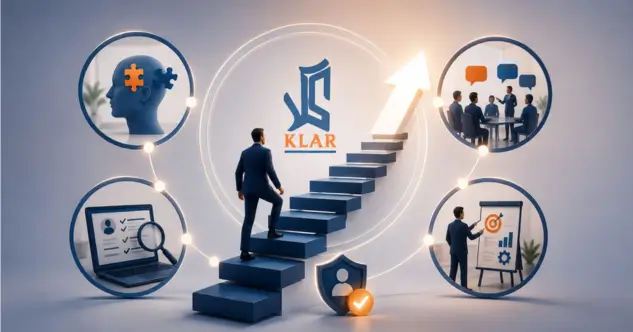
Klar supports leadership development through personality and behavioral analysis, individual development sessions, group programs, and customized corporate training. These solutions help individuals and organizations identify development needs and apply practical insights in the workplace.
Klar’s leadership development solutions include:
- Individual Personality and Behavioral Analysis: Personalized sessions that help participants understand behavioral patterns, identify strengths and development areas, and create an actionable development plan.
- Online Personality Analysis: Professional assessments that provide insights into behavioral patterns, leadership approaches, and decision-making styles.
- Group Development Programs: Interactive programs that help participants understand different personality types and improve how they work and communicate with others.
- Customized Corporate Training: Tailored development programs based on organizational needs and workplace challenges, available through in-person or online formats.
For a more personalized approach to understanding your leadership behaviors and development areas, explore Klar’s Advanced Personality & Behavioral Analysis Session and turn behavioral insights into practical steps for professional growth.
Conclusion
Leadership coaching provides a structured approach to developing stronger leadership behaviors and applying them to real workplace challenges. By focusing on individual goals, feedback, and practical action, it can support leaders at different stages of their careers.
With Klar’s leadership development solutions, individuals and organizations can identify development needs and turn insights into practical improvement. Explore Klar’s programs and take the next step in your leadership development.
FAQ
What is leadership coaching and how does it work?
Leadership coaching is a personalized process that uses feedback, goal setting, and practical guidance to improve leadership skills and behaviors.
What are the main benefits of leadership coaching for managers?
It can improve communication, decision-making, delegation, self-awareness, and team management.
How can leadership coaching improve leadership skills?
It helps leaders identify development areas, receive feedback, and practice new behaviors in real workplace situations.
How do I choose the right leadership coaching program?
Consider your goals, the coach’s experience, the level of personalization, the coaching approach, and how progress is measured.