

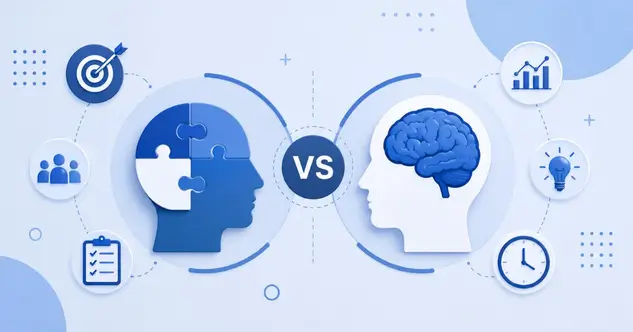
Personality vs IQ Tests: Understanding the Key Differences
When people want to learn more about themselves, they often come across two common types of assessments: personality tests and IQ tests. Although both are designed to provide insights about an individual, they measure completely different aspects of human behavior and thinking. This is why understanding the difference between personality tests and IQ tests is essential before deciding which assessment is more relevant to your goals, whether those goals involve career planning, personal development, education, or hiring.
The difference between personality tests and IQ tests goes beyond the questions they ask. Personality assessments are designed to explore behavioral preferences, communication styles, emotional tendencies, motivations, and interpersonal characteristics, while IQ tests focus on cognitive abilities such as logical reasoning, problem-solving, memory, and analytical thinking. Because they evaluate different dimensions of human potential, the results of one test cannot replace or predict the results of the other.
In this article, we will explain the difference between personality tests and IQ tests, explore how each assessment works, compare what they measure, discuss when each type of test is most useful, and examine whether they can be used together to provide a more comprehensive understanding of an individual’s strengths, abilities, and development opportunities.
What Is an IQ Test?

An IQ test, or Intelligence Quotient test, is a standardized assessment designed to measure a person’s cognitive abilities rather than their personality traits. It evaluates skills such as logical reasoning, problem-solving, verbal comprehension, memory, spatial reasoning, and processing speed. The results are typically presented as an IQ score that compares an individual’s cognitive performance with others in the same age group, making it a useful tool for understanding intellectual strengths and learning potential.
Unlike personality assessments, IQ tests do not measure behavior, emotions, communication style, or personal preferences. Instead, they focus exclusively on how a person processes information and solves intellectual challenges. Understanding the difference between personality tests and IQ tests is important because each assessment serves a different purpose. While an IQ test measures cognitive ability, it cannot explain how someone interacts with others, responds to stress, or approaches decision-making in everyday life.
According to EduBlox, IQ scores follow a normal distribution, with about 50% of the population scoring between 90 and 110. This shows that most people fall within the average range of cognitive ability, while higher or lower scores are much less common.
Difference Between Personality Tests and IQ Tests
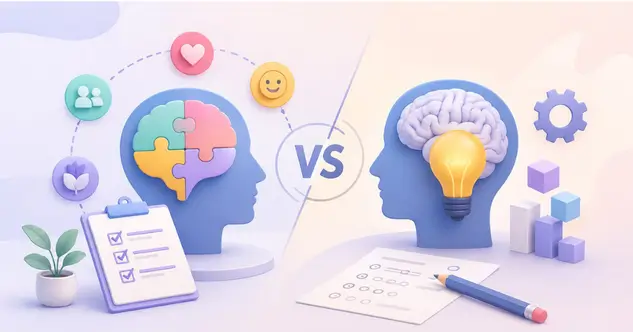
To better understand the difference between personality tests and IQ tests, it is helpful to compare them across several key aspects. The sections below explain what each test measures, how the results are interpreted, whether personality and intelligence are connected, and which assessment tends to remain more stable over time.
What Does Each Test Measure?
Personality Tests
- Measure behavioral traits and personal preferences.
- Assess communication style and emotional tendencies.
- Explore motivations, values, and interpersonal behavior.
- Focus on how people typically think, feel, and interact.
IQ Tests
- Measure cognitive and intellectual abilities.
- Evaluate logical reasoning and problem-solving skills.
- Assess memory, verbal comprehension, and spatial reasoning.
- Focus on mental performance rather than personality.
Example:
If two people apply for the same management position, an IQ test may show who performs better in analytical tasks, while a personality test may reveal who has stronger leadership, teamwork, and communication skills.
How Are the Results Interpreted?
Personality Tests
- Describe personality characteristics instead of giving a score.
- Identify strengths, communication styles, and behavioral preferences.
- Help improve self-awareness and personal development.
IQ Tests
- Provide a numerical IQ score based on standardized testing.
- Compare cognitive performance with people in the same age group.
- Indicate intellectual strengths in specific cognitive areas.
Example:
A personality assessment may describe someone as collaborative and adaptable, while an IQ assessment may report an IQ score of 120, indicating above-average cognitive ability.
Are Personality and Intelligence Connected?
- Personality and intelligence are related but measure different aspects of an individual.
- A high IQ does not determine someone’s personality traits.
- Likewise, personality traits do not predict intelligence levels.
- Both assessments provide valuable insights when interpreted together.
Example:
Someone may have a high IQ but struggle with teamwork or emotional regulation. Another person may have average cognitive ability but excel in communication, leadership, and relationship building.
Which Test Is More Stable Over Time?
Personality Tests
- Core personality traits are generally stable but may gradually change through life experiences and personal growth.
- Results can evolve as behavior and preferences develop over time.
IQ Tests
- Cognitive ability tends to remain relatively stable throughout adulthood.
- Scores may vary slightly depending on age, health, education, or testing conditions, but they usually remain consistent over time.
Example:
An individual’s personality may gradually develop through life experiences and professional growth, while IQ scores generally remain relatively stable throughout adulthood, although performance can vary depending on health, education, or testing conditions.
| Features | Personality Test | IQ Test |
| Primary Purpose | Understand personality traits, behavior, and preferences | Measure cognitive ability and intellectual performance |
| What It Measures | Personality, communications style, emotions, and motivations | Logical reasoning, memory, problem-solving, and analyitical thinking |
| Results | Personality profile or trait-based report | Numerical IQ score |
| Common Uses | Self-awareness, career development, hiring, leadership, and team building | ,Educational assessment, cognitive evaluation and giftedness identification |
| Can It Change Over Time | Personality traits are generally stable but may gradually develop | IQ scores are relatively stable, although performance may vary under certain conditions |
| Best For | Understanding how people think, behave, and interact | Understanding cognitive strengths and learning ability |
Both assessments provide valuable insights, but they answer different questions. Choosing the right one depends on whether you want to understand how you behave or how you think.
For a broader understanding of Difference Between Personality Tests and IQ Tests, explore The Ultimate Guide to Personality Assessments.
When Is an IQ Test the Right Choice?

An IQ test is most valuable when the goal is to understand cognitive abilities rather than personality traits. It can provide meaningful insights into how a person thinks, learns, and solves problems, making it useful in a variety of educational, clinical, and professional settings. The following situations explain when taking an IQ test may be the right choice:
· To evaluate cognitive strengths and weaknesses:
An IQ test helps identify areas where a person performs well, such as logical reasoning, memory, or verbal comprehension, while also highlighting cognitive skills that may need further development.
· To support educational planning:
Schools and educational professionals may use IQ tests to identify gifted students or better understand learning difficulties, allowing them to provide appropriate academic support.
· For psychological or clinical assessments:
Mental health professionals sometimes include IQ tests as part of a broader evaluation to better understand an individual’s cognitive functioning alongside other psychological factors.
· To understand learning potential:
IQ tests can provide insight into how a person processes information, solves unfamiliar problems, and adapts to intellectual challenges, helping educators and specialists make informed decisions.
· For research and scientific studies
Researchers may use standardized IQ tests to examine cognitive abilities across different populations or to study the relationship between intelligence and other psychological or educational factors.
Can Personality Tests and IQ Tests Be Used Together?
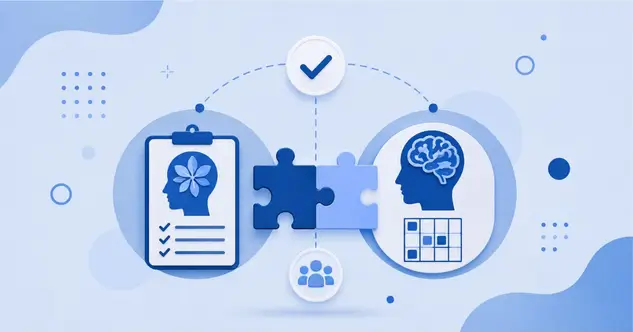
Personality tests and IQ tests complement each other by providing different types of insights. Together, they offer a broader view of an individual’s behavior and cognitive abilities, including:
- Providing a more complete understanding of an individual: A personality test explains behavioral traits, communication style, and personal preferences, while an IQ test measures cognitive abilities such as reasoning and problem-solving. Together, they create a more comprehensive profile.
- Supporting career planning and development: Combining both assessments can help identify careers that match a person’s working style as well as their intellectual strengths, making career decisions more informed.
- Improving leadership and team development: Organizations may use personality assessments to understand collaboration and leadership styles, while IQ tests provide additional insight into analytical thinking and learning ability when designing development programs.
- Enhancing educational and learning support: Educators and psychologists can use both assessments to better understand a student’s learning preferences alongside their cognitive abilities, allowing for more personalized support.
- Making assessment results more balanced: Neither test provides a complete picture on its own. Using both together offers a broader perspective by evaluating both behavioral characteristics and cognitive performance, leading to more informed decisions in educational, professional, or personal settings.
Common Misconceptions About Personality Tests and IQ Tests

Many people misunderstand what personality tests and IQ tests are designed to measure. Here are some of the most common misconceptions:
- Personality tests measure intelligence: Personality tests evaluate behavioral traits, preferences, and communication styles, not cognitive ability or intelligence.
- IQ tests can describe someone’s personality: IQ tests measure reasoning, problem-solving, and other cognitive skills, but they do not explain behavior, emotions, or personal characteristics.
- A high IQ guarantees success: While intelligence can support academic or professional performance, success is also influenced by factors such as motivation, emotional intelligence, experience, and communication skills.
- Personality test results never change: Although personality traits are generally stable, they can gradually develop over time as people gain new experiences and adapt to different environments.
- One test is better than the other: Neither assessment is superior because they serve different purposes. Choosing the right test depends on whether you want to understand personality traits or cognitive abilities.
Why Understanding the Difference Between Personality Tests and IQ Tests Matters

Understanding the difference between personality tests and IQ tests helps you choose the right assessment based on your goals instead of expecting one test to provide all the answers. While personality tests focus on behavioral traits and preferences, IQ tests measure cognitive abilities, making each assessment valuable in different situations such as education, career planning, leadership development, and personal growth.
Recognizing how these assessments complement each other can lead to better decisions and more meaningful self-awareness. If you want to build on these insights and develop practical leadership and interpersonal skills, explore Klar’s leadership courses and leadership coaching sessions to gain deeper knowledge and apply personality insights effectively in real-world situations.
Conclusion
Understanding the difference between personality tests and IQ tests allows you to choose the assessment that best matches your goals. While personality tests help explain how you behave, communicate, and make decisions, IQ tests measure how you think, reason, and solve problems. Rather than competing with each other, these assessments provide different types of insights that can support personal, educational, and professional growth.
The real value of these tests lies not in the scores themselves, but in how you use the results to improve self-awareness and make better decisions. Whether you want to understand your strengths, develop your leadership potential, or plan your career more effectively, choosing the right assessment is the first step toward meaningful growth.
FAQ
What is the difference between personality and IQ?
Intelligence is assessed using ability tests (such as IQ tests), whereas personality is assessed using questionnaires. It has been suggested that intelligence should reflect an individual’s maximal performance, while personality should reflect their typical behaviour.
What is more accurate than an IQ test?
Alternative: If your goal is to predict future achievement, you don’t need an IQ test. The best predictor will be past achievement — past course grades, past achievement test scores. They will predict future achievement better than will an IQ test.
Which personality tests are accurate?
Any personality test can be fun and intriguing. But from a scientific perspective, tools such as the Big Five Inventory (and others based on the five-factor model) and those used by psychological scientists, such as the MMPI, are likely to provide the most reliable and valid results.
How do aptitude tests differ from IQ tests?
Simply put, an IQ (Intelligence Quotient) test measures statistically how intelligent a person is while an aptitude (General Intelligence) test measures how well that person can apply their intelligence to different scenarios