

Are personality tests scientifically valid?
Can a personality test really measure who you are, or is it simply assigning labels based on a series of questions? This question has fueled debate among psychologists, researchers, employers, and individuals for decades. While personality tests are widely used in hiring, leadership development, education, and self-discovery, many people still wonder whether their results are scientifically trustworthy.
The challenge is that not all personality assessments are created equally. Some personality assessments are supported by decades of psychological research and demonstrate strong reliability and validity, while others face criticism for limited scientific evidence or inconsistent results. Understanding the scientific foundation behind these assessments is essential for evaluating how accurately they measure personality and how confidently their results can be applied.
In this article, we explore whether personality tests are scientifically valid by examining the factors that determine their validity and reliability, how personality assessments are developed and evaluated, and why some tests face scientific criticism.
Are personality tests scientifically valid?
The short answer is yes but not all personality tests are equally scientific. Research shows that personality assessments can be scientifically valid when they are developed using established psychological theories, tested for reliability and validity, and supported by ongoing research. These assessments can provide meaningful insights into personality traits, workplace behavior, leadership potential, and individual development.
This is reflected in a SHRM survey, where 62% of HR professionals reported that personality tests can be useful in predicting job-related behavior or organizational fit when they are properly vetted and validated.
However, scientific validity varies from one assessment to another. Some personality tests are supported by decades of research and strong statistical evidence, while others face criticism for inconsistent results or limited predictive accuracy. For this reason, psychologists evaluate personality assessments based on factors such as reliability, validity, standardization, and empirical support rather than popularity alone.
What Factors Determine the Scientific Validity of a Personality Test?

Several factors are used by researchers and psychologists to determine whether a personality assessment meets scientific standards:
Construct Validity
A personality test should accurately measure the trait it claims to assess. For example, if a test is designed to measure leadership potential, the questions and results should focus on leadership-related characteristics rather than unrelated traits such as sociability or confidence alone.
Criterion Validity
A scientifically valid test should demonstrate a meaningful connection between test results and real-life outcomes.
For instance, if individuals who score highly on a leadership assessment consistently perform well in leadership roles, this provides evidence that the assessment is measuring something relevant and useful.
Reliability
Reliability refers to consistency. If a person completes the same personality test multiple times within a reasonable period, the results should remain relatively similar. Significant changes in scores without any major life changes may indicate that the assessment lacks reliability.
Standardization
Every participant should complete the assessment under the same conditions and receive results based on the same scoring process. This helps ensure that differences in results reflect actual differences in personality rather than differences in testing procedures.
Normative Data
Personality test results become more meaningful when they are compared with data collected from large groups of people. For example, instead of simply stating that someone scored 75 on a particular trait, the assessment may show how that score compares with others in a similar age group, profession, or population.
Ongoing Validation Research
Scientific validity is not established once and then ignored. High-quality personality assessments are continuously tested and updated using new research findings. This ongoing evaluation helps ensure that the assessment remains accurate, relevant, and applicable to different populations and workplace environments.
For a broader understanding of whether personality tests are scientifically valid, explore the Ultimate guide to personality Assessments.
How Are Personality Tests Developed and Validated?

Many people think personality tests are just a set of questions that lead to a final label or type. However, scientifically credible tests are usually built through a structured process that includes research, testing, data analysis, and review. Before a personality test can be trusted, it typically goes through several key stages:
Research Design:
The development process begins with defining the specific personality traits the assessment is intended to measure. Researchers review existing psychological theories and scientific literature to identify the behaviors, attitudes, and characteristics associated with those traits. Based on this research, they create an initial pool of questions designed to capture meaningful differences between individuals.
Pilot Testing:
Once the assessment has been refined, researchers conduct validation studies using larger and more diverse populations. These studies evaluate whether the test accurately measures personality and whether its results are associated with meaningful outcomes such as job performance, leadership effectiveness, teamwork, or academic achievement. The stronger these relationships are, the stronger the evidence supporting the test’s validity.
Statistical Analysis:
Researchers use statistical methods to examine how well individual questions measure the targeted personality traits. This stage helps identify weak or redundant items and determines whether groups of questions consistently assess the same psychological construct. Statistical analysis also provides evidence regarding the reliability and internal consistency of the assessment.
Validation Studies:
Once the assessment has been refined, researchers conduct validation studies using larger and more diverse populations. These studies evaluate whether the test accurately measures personality and whether its results are associated with meaningful outcomes such as job performance, leadership effectiveness, teamwork, or academic achievement. The stronger these relationships are, the stronger the evidence supporting the test’s validity.
Ongoing Revisions:
The development process does not end when a personality test is published. High-quality assessments are continuously reviewed and updated as new research becomes available. Researchers may revise questions, update scoring models, or test the assessment with different populations to ensure that it remains accurate, reliable, and relevant over time.
What Makes a Personality Test Scientifically Reliable?

According to a SHRM survey, only 18% of organizations reported using personality tests in hiring or promotion decisions, while 82% indicated that they do not currently use them in these processes. This suggests that many organizations remain cautious about using personality assessments for employment-related decisions unless they are properly validated.
For a personality test to be scientifically reliable, it must provide stable and consistent results rather than outcomes that change randomly from one assessment to another. Researchers evaluate this reliability using several key criteria:
Test-Retest Reliability
If a person takes the same personality test more than once within a reasonable period, the results should remain relatively similar. While minor differences are normal, major changes without any significant life events may indicate that the assessment is not measuring personality consistently.
Internal Consistency
The questions within a personality test should work together to measure the same trait. For example, if several questions are intended to assess extraversion, the responses should show a consistent pattern rather than producing conflicting results. High internal consistency suggests that the assessment is measuring a clearly defined characteristic.
Measurement Stability
Personality traits tend to be relatively stable over time. A scientifically reliable test should reflect this stability by producing scores that remain reasonably consistent unless there is a genuine change in the individual’s behavior, experiences, or development.
Reproducibility of Results
A reliable assessment should produce similar findings when administered to different groups of people under similar conditions. Researchers often test personality assessments across various populations, industries, and cultural settings to determine whether the results can be reproduced consistently.
When a personality test demonstrates strong performance across these areas, researchers can have greater confidence that its results are dependable and suitable for research, development, and workplace applications.
Which Personality Tests Have the Strongest Scientific Support?
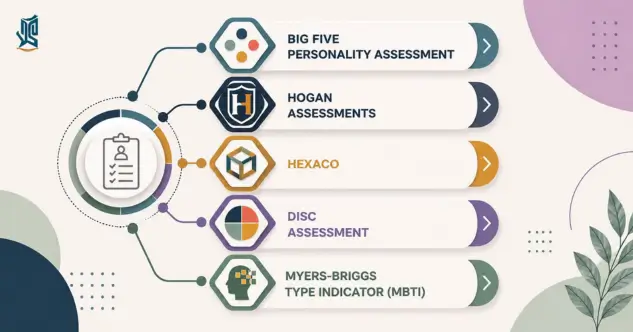
Several personality assessments are commonly used in research, workplace development, and employee evaluation, including:
- Big Five Personality Assessment: Measures personality across five broad traits: openness, conscientiousness, extraversion, agreeableness, and neuroticism. It is widely regarded as one of the most scientifically supported personality frameworks.
- Hogan Assessments: Designed primarily for workplace and leadership applications. These assessments evaluate normal personality traits, leadership potential, and behaviors that may emerge under stress.
- HEXACO: A trait-based personality model that measures six dimensions of personality, including Honesty-Humility. It is supported by growing research and is often viewed as an extension of traditional trait models.
- DISC Assessment: Focuses on four behavioral styles: Dominance, Influence, Steadiness, and Conscientiousness. It is widely used for communication and team development, although its scientific support is generally considered more limited than trait-based models.
- Myers-Briggs Type Indicator (MBTI): Classifies individuals into personality types based on preferences related to perception and decision-making. While extremely popular, the MBTI has faced scientific criticism regarding reliability and consistency, making it one of the most debated personality assessments in psychology.
Why Do Some Personality Tests Face Scientific Criticism?

Not all personality assessments meet the same scientific standards. Researchers have raised concerns about some tests for several reasons:
- Oversimplification: Some assessments attempt to explain complex human personality using a limited number of categories, which may overlook important individual differences.
- Binary Classifications: Certain tests place people into fixed personality types, even though many personality traits exist on a spectrum rather than in strict categories.
- Inconsistent Results: Some individuals receive noticeably different results when taking the same assessment at different times, raising questions about reliability.
- Lack of Predictive Accuracy: Not all personality tests are equally effective at predicting real-world outcomes such as job performance, leadership success, or workplace behavior.
- Confirmation Bias: People may focus on descriptions that seem accurate while ignoring information that does not match their self-perception, making results appear more precise than they actually are.
Understanding the scientific strengths and limitations of personality assessments is only the first step. Organizations that want to apply these insights effectively can benefit from structured development programs. Turn assessment results into real workplace impact with Klar’s Customized Corporate Training Solutions for companies.
Conclusion
Personality tests can be scientifically valid when they are built on clear psychological theory, tested through rigorous research, and shown to produce reliable and meaningful results. Their value does not come from giving a quick label, but from how accurately they measure personality traits and how responsibly their results are interpreted.
The more important point is that scientific validity is not the same across all personality assessments. Some tools are supported by stronger evidence than others, which makes it essential to look at how a test was developed, whether it has been validated, and whether it is suitable for the purpose it is being used for. When applied carefully and combined with other sources of information, personality tests can support better understanding, development, and decision-making without being treated as absolute judgments.
FAQ:
Are there any scientifically proven personality tests?
Any personality test can be fun and intriguing. But from a scientific perspective, tools such as the Big Five Inventory (and others based on the five-factor model) and those used by psychological scientists, such as the MMPI, are likely to provide the most reliable and valid results.
Do personality tests actually work?
Yes, personality tests “work” to varying degrees depending on how you use them.
Is the MBTI scientifically valid?
No, the Myers-Briggs Type Indicator (MBTI) is not considered scientifically valid by mainstream psychologists.
Can personality tests predict success?
While no personality test can guarantee professional achievement, research indicates that certain traits correlate with career success. Conscientiousness, for instance, is consistently linked to job performance across industries.