


Corporate Training in UAE: How to Improve Employee Performance
Developing employees’ skills helps improve organizational performance, increase productivity, and keep pace with the rapid changes in the labor market. As a result, corporate training in UAE has become one of the key tools companies rely on to develop their employees’ competencies, strengthen their competitiveness, and achieve their goals efficiently. In this article, we explore the concept of corporate training and its importance, its main implementation methods, the challenges it faces, and the ways to measure its effectiveness to ensure tangible results.
What Is Corporate Training, and Why Is It Important for Companies in the UAE?
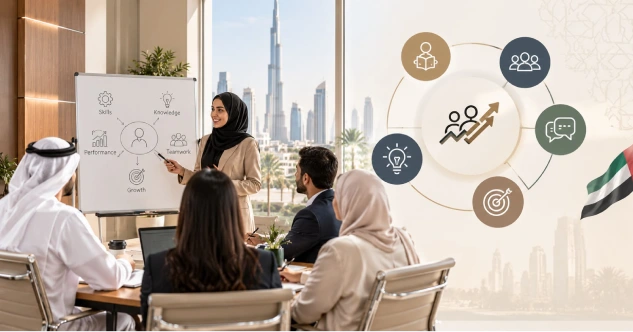
Corporate training in UAE is a structured process aimed at developing employees’ skills and knowledge through training programs that help enhance their professional competencies and improve the quality of work. It is distinguished by being a continuous process that evolves according to the company’s needs and the requirements of the labor market.
The importance of corporate training lies in strengthening collaboration among members of the same team and improving effective communication between the different departments within the organization, which helps coordinate efforts and achieve shared goals. These programs are not limited to administrative staff; rather, they cover all job levels, as they help employees develop their technical and professional skills, keep pace with changes in the work environment, and raise their level of performance.
Developing these skills becomes even more important given the continuous changes in the labor market. In The Future of Jobs Report 2025, the World Economic Forum states that 63% of employers consider skills gaps a major barrier to transforming their business, which underscores the importance of continuous training in closing these gaps and keeping up with labor market requirements.
What Are the Benefits of Corporate Training in Developing Employee Performance in the UAE?

Corporate training in UAE contributes to developing employees’ skills and raising work efficiency, which helps companies improve their performance and achieve their goals. Its most notable benefits include:
1. Enhancing Employee Efficiency and Productivity
Training equips employees with the knowledge and skills needed to perform their tasks accurately and effectively, and helps them use modern technological tools and apply professional best practices, which increases productivity and reduces errors and the waste of time and effort.
2- Increasing Employee Satisfaction and Supporting Career Growth
Providing training and development opportunities helps strengthen employees’ sense of being valued and of the organization’s interest in their careers, which raises their level of satisfaction and commitment to the organization. It also gives them the skills needed to take on new responsibilities and increases their chances of promotion and career advancement.
3. Fostering Innovation and Creativity
Training helps develop critical and analytical thinking skills and encourages employees to devise new solutions to problems and improve work methods, which supports the improvement of products and services and keeping pace with market changes.
4. Improving Competitiveness and Compliance
Training helps improve the quality of products and services and increase operational efficiency, which strengthens the company’s ability to meet customer needs and maintain its market position. It also helps familiarize employees with the relevant laws, regulations, and occupational safety standards, which reduces risks and supports compliance with regulatory requirements.
5. Developing Leadership and Management Skills
Training programs designed for managers and leaders help develop skills in team management, communication, problem-solving, and strategic decision-making. This is reflected in the efficiency of teamwork and helps the organization direct its human resources effectively and achieve its goals.
Business manager development becomes particularly important for organizations seeking to strengthen their leaders’ ability to manage teams, make decisions, and handle everyday workplace challenges effectively.
What Are the Foundations of Successful Corporate Training in UAE?

The success of corporate training in UAE requires planning training programs according to the needs of the organization and its employees, providing the resources necessary to implement them, and evaluating the results to ensure the desired goals are achieved. The main foundations of its success are as follows:
- Identifying training needs: Analyzing employee performance and identifying skills and knowledge gaps to ensure that training programs align with the organization’s needs and goals.
- Designing the training program: Setting clear objectives and selecting content that suits employees’ roles and levels, while diversifying training methods to match the nature of the targeted skills. An employee development program can be part of a broader plan that helps organizations identify the skills they need to develop and select suitable development methods for different employee groups.
- Considering the nature of the work environment in the UAE: Adapting training content to the nature of the sector and the needs of work teams, while taking into account the linguistic and cultural diversity among employees and the professional and regulatory requirements related to the organization’s field of work.
- Allocating the necessary resources: Providing an adequate budget, suitable training tools, and qualified trainers to ensure programs are implemented efficiently.
- Monitoring results and continuous improvement: Tracking the extent to which the program achieves its objectives, and using the results and feedback to develop programs in line with evolving business needs.
What Are the Effective Methods of Corporate Training in UAE?

Corporate training methods vary according to the nature of the work, employees’ needs, and the goals the organization seeks to achieve. The most notable of these methods include:
- Practical and hands-on training: Simulating real work situations to develop practical skills and improve problem-solving and decision-making abilities.
- Online training: Delivering e-learning content that allows employees to learn flexibly anywhere and at any time.
- One-on-one training: Assigning a trainer to follow up with the employee and develop their skills according to their needs and professional level.
- Collaborative group training: Bringing employees together to exchange experiences and work on shared tasks, which strengthens communication and teamwork.
What Are the Challenges of Corporate Training, and How Can They Be Overcome?

Corporate training programs in the UAE face challenges that may limit their effectiveness, such as difficulty in accurately identifying needs, weak application of skills, differing employee needs, and time and cost constraints. Addressing them requires choosing solutions suited to the nature of each challenge. The most notable of these are:
1. Failure to Identify Training Needs
Failing to analyze the needs of the organization and its employees before designing programs leads to delivering content that does not address actual performance gaps, which reduces the effectiveness of training and wastes resources.
How to overcome this challenge:
- Analyze employee performance and identify the skills that need development.
- Draw on feedback from managers and employees to determine actual needs.
- Link the program’s objectives to the identified performance gaps.
2. Focusing on the Theoretical Side
Employees may acquire new information during training, but they struggle to apply it if the programs do not include activities that simulate their daily tasks, which limits the transfer of knowledge into practices that improve performance.
How to overcome this challenge:
- Integrate practical exercises and simulations into training programs.
- Use real-life cases related to the nature of the work.
- Assign employees practical tasks after the training ends.
3. Ignoring Differences in Employee Needs
Employees’ training needs vary according to their roles, experience, and professional levels. Therefore, a one-size-fits-all program may not achieve the desired results if it does not account for differences in roles, experience, and employee levels.
How to overcome this challenge:
- Design programs that suit the nature of each role and level of experience.
- Provide diverse training tracks according to employees’ needs.
- Take linguistic and cultural differences into account when preparing content.
4. Weak Evaluation and Follow-Up
Measuring participants’ satisfaction with a training course is not enough to judge its success; it is also necessary to know how well they can apply what they have learned at work. A lack of follow-up makes it difficult to identify shortcomings and improve subsequent programs.
How to overcome this challenge:
- Conduct assessments before and after training.
- Monitor the application of skills in the work environment.
- Measure changes in performance indicators linked to the training objectives.
5. Low Engagement and Time and Cost Constraints
Traditional training methods may lead to weak employee participation, while work pressure and limited budgets restrict their ability to attend programs. Therefore, organizations need to choose flexible solutions that fit the available time and resources.
How to overcome this challenge:
- Use interactive activities and group discussions to boost participation.
- Offer e-learning and short sessions to fit work schedules.
- Set training priorities and allocate the budget according to the organization’s needs and goals.
How Can the Effectiveness of Corporate Training in UAE Be Measured?

Measuring the effectiveness of corporate training helps determine the extent to which training programs achieve their objectives, identify their impact on employee performance, and develop them in line with the organization’s needs. This effectiveness can be measured through a set of indicators:
- Measuring engagement and satisfaction: Gathering participants’ opinions on the content, the trainer, and the delivery style, and assessing their level of engagement with the program.
- Measuring performance improvement: Tracking indicators of productivity, work quality, error rates, and customer satisfaction, and comparing them before and after training.
- Assessing skill development: Using practical tests and managers’ observations to determine the extent to which employees have acquired the targeted skills and knowledge and their ability to apply them.
- Measuring return on investment: Comparing the cost of the training program with the results it has achieved, such as increased productivity or reduced errors and employee turnover rates.
Looking to turn your training goals into a practical development plan? Explore Klar’s corporate training programs, designed around your organization’s needs to strengthen performance, develop teams, and deliver measurable training outcomes.
Conclusion
Corporate training in UAE represents an investment in developing employees and improving company performance in the long term. Its success depends on choosing programs that align with the needs of the organization and its employees, while continuously monitoring and improving their results. In this way, organizations can build more efficient teams, keep pace with labor market requirements, and strengthen their ability to achieve their goals.
FAQ:
How Often Should Employees Be Trained Within the Organization?
There is no single timeframe that suits all organizations, as the frequency of training depends on the nature of the roles, employees’ skill levels, and changes in tools, systems, and work requirements. Therefore, it is better to schedule training according to actual needs rather than relying on a fixed schedule for all employees.
Is Corporate Training Suitable for Small Companies?
Yes, small companies can implement training programs that fit the number of employees, their needs, and the available resources, while focusing on the skills most closely related to business goals and team performance.
What Is the Difference Between One-on-One and Group Training Within Companies?
One-on-one training focuses on the needs and professional level of a specific employee, while group training brings several employees together to develop shared skills, exchange experiences, and strengthen collaboration among team members.
How Does Training Help Reduce Employee Errors?
Training helps clarify work procedures, strengthen employees’ understanding of their tasks, and develop their ability to use tools and systems correctly, which reduces errors and improves the quality of results.